
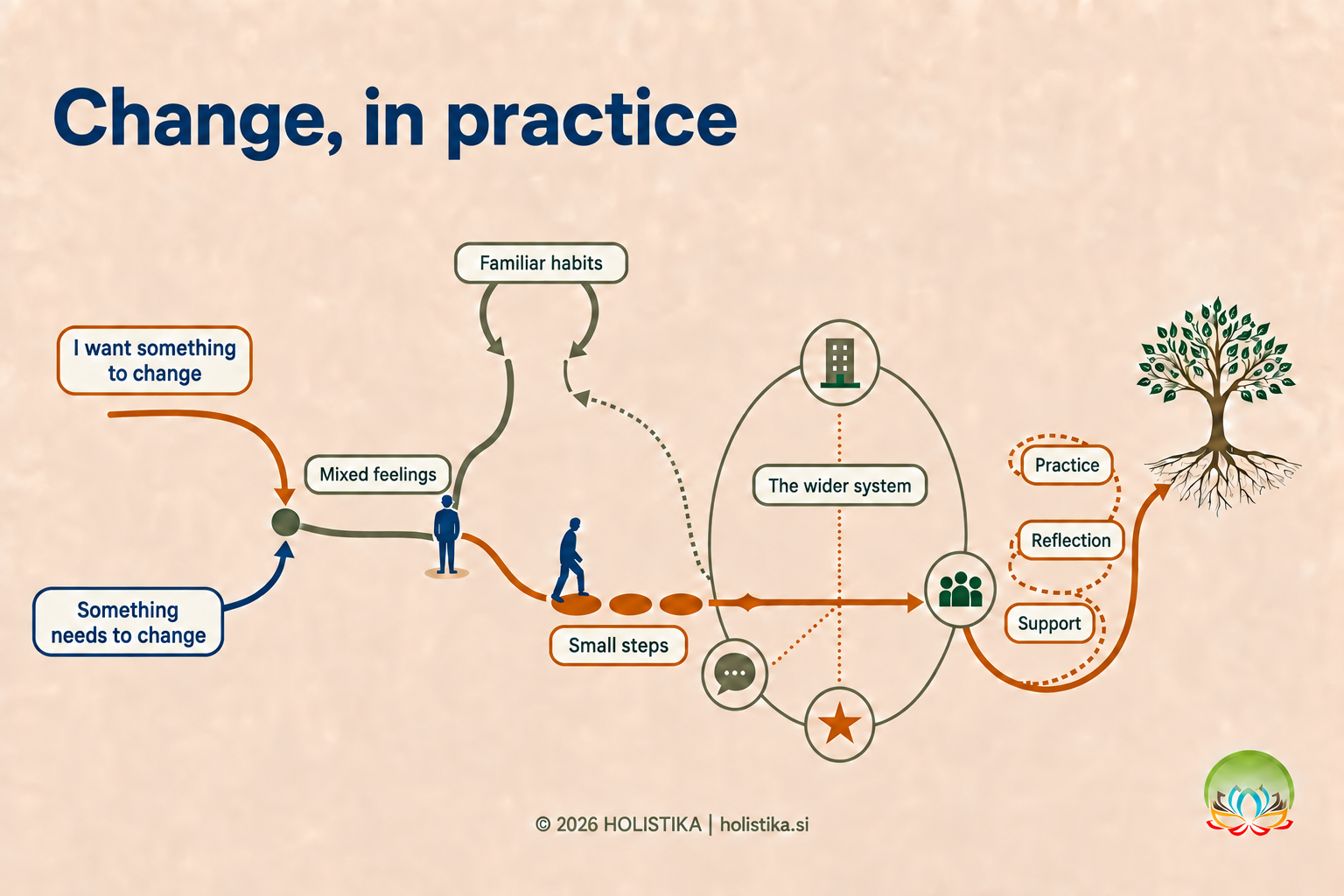
What it takes to move change from a good intention into everyday practice, through the habits we notice, the small actions we take and the systems around us.
I experienced my first near-total solar eclipse in August 1999. The birds suddey went quiet, the light changed, and for a few moments it felt as though the whole world had stopped. I found it fascinating, but also strangely unnerving, almost as if my heart had briefly contracted along with the disappearing sun.
Change can feel much the same. We may be curious and excited about what is coming, while another part of us feels uneasy as something familiar slips out of view. Both reactions are natural. Being open to change does not mean we have to feel positive and confident every step of the way. Fascination and discomfort can coexist.
Sometimes we initiate the change ourselves. We decide to lead differently, restructure a team, leave a familiar role or begin something new. At other times, change arrives through a decision made elsewhere: a new owner, a different strategy, a family situation, an unexpected loss or circumstances that leave us with little choice.The starting points may be different, but the challenge soon becomes similar. Whether we chose the change or the change chose us, we still have to find a way to live and work within the new reality.This is where intention meets practice, and where change becomes more complicated than it first appeared. The reflections that follow grew out of a series of shorter posts, brought together here and expanded.
What we return to under pressure
We often talk about openness to change as though it were a decision we make once. We understand the reason, agree with the direction and commit ourselves to moving forward. Yet commitment made in a calm meeting room can feel very different when deadlines tighten, uncertainty grows and the consequences become real.
That is often when familiar habits return.
A leader who wants to involve others begins making decisions alone. Someone who aims to delegate starts checking every detail. A team that agreed to communicate openly becomes cautious when the first disagreement appears. An organisation that wants people to take more responsibility adds another level of approval when something goes wrong.
We may interpret this as inconsistency or a lack of commitment. Often, it is something more human. Under pressure, we reach for responses that have helped us feel safe, competent or in control before.These habits did not appear by accident. The leader who checks every detail may once have been rewarded for preventing mistakes. The person who avoids disagreement may have learned that speaking openly carries a cost. The manager who makes decisions alone may be working in an environment where accountability is individual, even when collaboration is encouraged.
Old habits are therefore more than obstacles. They contain information. They show us what we reach for when the pressure rises, what we fear losing and what the environment has taught us to protect. Instead of asking, “Why am I doing this again?” we might ask, “What is this habit trying to do for me?”Perhaps it is trying to protect speed, certainty, reputation or belonging. Once we understand its purpose, we have a better chance of finding a new response that meets the same need without taking us back to the old pattern.
At the beginning of a change, we may ask ourselves, “How do I want to lead through this?” Once the pressure rises, another question becomes equally important: “What do I return to when things become difficult?”The answer tells us where the real practice needs to begin.
Small changes are easier to practise
Awareness matters, but awareness alone does not change what happens next.A leader may know that they need to listen more. A team may recognise that it avoids difficult conversations. An organisation may understand that decisions are taking too long. These insights can be valuable, but they remain abstract until they become visible in everyday behaviour.This is where we often make change harder than it needs to be. We choose an ambition that sounds meaningful but gives us little guidance in the moment: I will become a better listener. I will delegate more. We will collaborate more effectively. I will be more confident.
The intention is clear, but what does it ask us to do differently during the next meeting, decision or difficult conversation?
A smaller step is easier to practise. Ask one more question before offering an answer. Leave a little more silence in the conversation. Hand over one decision that you would normally make yourself. Name a concern before it turns into quiet resistance. Ask the person closest to the work what they are seeing.
These actions may look modest, but they do something important. They give change a shape. They also give us something concrete we can observe, such as whether we paused before answering or let someone else decide. That is more useful than a general judgement about whether we are “good at change.”
Small steps are sometimes dismissed as lacking ambition. I see them differently. A small step is a way of testing a new path without pretending we already know exactly where it will lead. It allows us to learn from reality.
Perhaps delegating one decision reveals that the other person needs more context. Perhaps asking an additional question brings forward an issue that would otherwise have remained hidden. Perhaps leaving more silence initially feels uncomfortable, but gradually encourages others to contribute. Each attempt tells us something. We can repeat it, adjust it or choose a better step. This is how change begins to move from an idea into a capability.
A more useful question may therefore be: “What is one small thing I could do differently today, in a situation that actually matters?”
When the system pulls us backwards
Changing our own behaviour is only part of the story. What is happening around us matters too.
A leader may want to delegate more, while still being held responsible for every detail. A team may be encouraged to experiment, but mistakes continue to be criticised. People may be asked to collaborate, while targets and rewards remain entirely individual. Managers may be told to empower their teams, but important decisions still require several layers of approval.
In each case, the official message points in one direction while the experience of working in the organisation points in another. People usually learn which message to trust.
This is why behaviour cannot be separated from context. What we sometimes call resistance may be a sensible response to conflicting expectations. People notice what receives attention, what gets rewarded and what happens when something goes wrong, and they adapt accordingly.
If an organisation says that experimentation matters but reacts harshly to the first unsuccessful attempt, people learn to minimise risk. If collaboration is encouraged but individual results determine recognition and progression, people learn to protect their own performance. If leaders are asked to delegate but are questioned about every operational detail, they learn to stay closely involved.
The system is always teaching, even when nobody intended to design the lesson. For change to last, goals, responsibilities, rewards and everyday leadership responses need to support the new behaviour. This does not mean every part of the organisation must be redesigned before an individual can take a different step. It does mean we need to notice where the surrounding environment supports the change and where it quietly pulls against it.
Sometimes a small adjustment is enough. A manager can respond to an honest mistake with curiosity rather than criticism. A team can add a shared objective alongside individual targets. A leader can clarify which decisions genuinely belong to others and then resist the urge to reclaim them. A meeting can make room for concerns before moving to solutions. These choices send a signal about which behaviours are truly welcome. They also remind us that sustainable change is a shared responsibility. We cannot ask one person to carry a change that the wider system repeatedly undermines.
Before concluding that someone lacks commitment, it may be worth asking what happens when they try the new behaviour, and what would need to change around them to make that response easier to sustain.
Sustainable change asks as much of the system as it does of the person trying to change.
What helps change last
A new behaviour can feel awkward long before it begins to feel natural.
We may understand it, believe in it and still feel clumsy when we try it. A leader accustomed to providing answers may worry that asking questions makes them appear uncertain. Someone learning to set boundaries may feel guilty before they feel clear. A team practising open disagreement may initially experience more tension rather than less.
This awkward stage is easy to misread. We may assume that the new approach is failing when, in fact, we are simply encountering the discomfort of doing something unfamiliar.
Meaningful change rarely happens in one decisive moment. It grows through repetition, reflection and adjustment.
Repetition gives the new behaviour a chance to become more available when we need it. Reflection helps us understand what happened rather than simply judging whether we succeeded. Adjustment keeps the practice connected to reality. After a difficult situation, it can help to ask simply: what did I notice, and what would I like to try next time?
Feedback, supportive conversations and coaching can deepen this process. Their purpose is not to monitor whether someone is changing quickly enough. They create a place to examine what is happening beneath the surface, including the tensions between intention, habit and environment. They also help keep the change visible after the initial enthusiasm fades. This matters because everyday work rarely protects space for a new behaviour. Urgent tasks return. Calendars fill. Attention moves elsewhere. Unless the new practice is revisited, the familiar path remains the easiest one to take.
Support can come from many places: a coach, a colleague, a manager, a team agreement, a regular reflection or a simple question included in a weekly meeting. What matters is that the change continues to receive attention after the announcement, workshop or initial decision has passed.
Change is a path we make visible by walking it. Looking across the whole journey, change starts to appear less like a straight line and more like an ongoing conversation.
There is a conversation within us, between the part that wants something new and the part that trusts what is familiar. There is a conversation between intention and daily practice. And there is a conversation between the individual and the system in which the change is expected to take place.
For change to move forward, all three need attention. We need enough awareness to recognise what we return to under pressure. We need a small, specific action that gives us another path to take. We need an environment that supports, or at least stops undermining, that choice. And we need repetition, reflection and support so the unfamiliar response gradually becomes one we can trust.
No single element is enough on its own. Insight without practice remains an idea. Practice without support can disappear under pressure. Individual effort within an unchanged system eventually becomes exhausting. Structural change without attention to human habits may alter processes while leaving everyday behaviour largely untouched. Together, however, these elements can carry change from intention into practice, and from practice into something that lasts.
The eclipse I witnessed in 1999 lasted only a few minutes. The light returned and the birds returned to chirping and singing. Yet for those brief moments, the familiar world looked and felt different. Perhaps that is why the experience stayed with me.
Change also asks us to spend some time in unfamiliar light. We may feel fascinated, unsettled or both. We do not need to have complete confidence in the path ahead. We only need enough awareness to recognise the next choice, enough courage to try it and enough support to keep going.
Insight may open the door, but practice is what takes us through it.
Change rarely happens all at once. It happens in the next choice we make.
